
Gallery


Table of contents
- Overview
- Understanding Bali Property Ownership: Leasehold vs. Freehold
- Freehold: Hak Milik for Indonesian Citizens
- Leasehold: Hak Sewa for Foreigners
- Right to Build (Hak Guna Bangunan - HGB) explained
- What are the Key Differences Between Leasehold and Freehold in Bali?
- Ownership Duration and Control
- Transferability and Inheritance
- Renegotiation and Extension Terms
- Financial Implications: Cost Comparison for 2026
- Initial Capital Outlay
- Ongoing Costs and Taxes
- Resale Value Projections
- What are the Legal Considerations for Foreign Investors?
- Notary and Legal Due Diligence
- Foreign Ownership Restrictions
- Investment Vehicle Structures (e.g., PMA Company)
- Risk Assessment: Leasehold Challenges and Freehold Security
Framework
- Overview
- Understanding Bali Property Ownership: Leasehold vs. Freehold
- Freehold: Hak Milik for Indonesian Citizens
- Leasehold: Hak Sewa for Foreigners
- Right to Build (Hak Guna Bangunan - HGB) explained
Cluster links
Related in cluster
Comparative table
| Metric | Value | Note |
|---|---|---|
| Gross yield | Model range | Pre-cost metric |
| Net yield | Scenario range | After recurring costs |
| Liquidity | Medium to High | Exit depth |
| Legal safety | Scored | Title + process clarity |
| Tax efficiency | Profile-dependent | Investor jurisdiction |
Overview
Deciding between Bali leasehold and freehold property in 2026 hinges primarily on your investment horizon, budget, and desired level of control. Each ownership structure offers distinct advantages and disadvantages that significantly impact foreign investors' strategies in this dynamic market. Understanding Bali Property Ownership: Leasehold vs. Freehold What are the Key Differences Between Leasehold and Freehold in Bali? Financial Implications: Cost Comparison for 2026 What are the Legal Considerations for Foreign Investors? Risk Assessment: Leasehold Challenges and Freehold Security Maximizing ROI: Investment Strategies for Each Ownership Type Is Leasehold Right for Short-Term Investments? Navigating the Acquisition Process: A Step-by-Step Guide What Does the Future Hold for Bali Real Estate?
Understanding Bali Property Ownership: Leasehold vs. Freehold
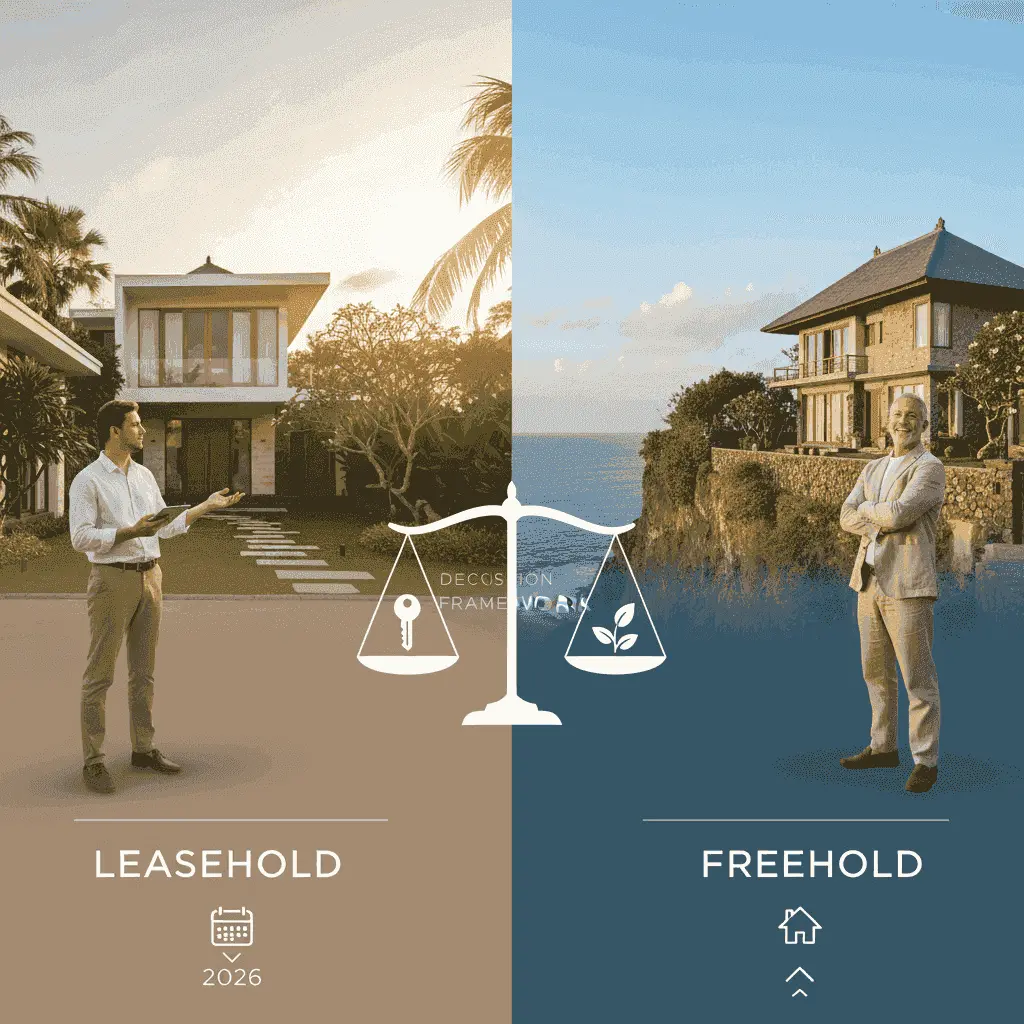
Bali property ownership for foreigners is primarily structured through leasehold agreements, while freehold ownership is generally reserved for Indonesian citizens. This fundamental distinction shapes every aspect of your investment journey.
Freehold: Hak Milik for Indonesian Citizens
Hak Milik, or Freehold title, grants full, perpetual ownership of both land and any structures on it to Indonesian citizens. This is the strongest form of ownership available under Indonesian law, offering complete control and the ability to transfer or inherit the property without duration limits.
Leasehold: Hak Sewa for Foreigners
Leasehold, known as Hak Sewa, allows foreigners to possess and use land and property for a defined period, typically 25 to 30 years, with options for extension. This is the most common and accessible pathway for international investors to acquire property in Bali, granting significant rights during the lease term but not perpetual ownership.
Right to Build (Hak Guna Bangunan - HGB) explained
The Right to Build (HGB) grants the right to construct and own buildings on land for a set period, typically 30 years with a 20-year extension, even if the land itself is not owned. While not direct land ownership, HGB can be used by Indonesian companies (including PMA foreign investment companies) and individuals, offering a robust framework for development and long-term use, often convertible to Hak Milik for Indonesian entities under certain conditions.
What are the Key Differences Between Leasehold and Freehold in Bali?
The primary differences lie in ownership duration, legal control, transferability, and the eligibility criteria for each type of title. Understanding these distinctions is crucial for a sound investment.
Ownership Duration and Control
Freehold offers perpetual ownership, providing ultimate control over the asset, whereas leasehold provides control only for the duration of the lease term. This difference dictates long-term planning and how investors can utilize or alter their property.
Transferability and Inheritance
Freehold properties are easily transferable and inheritable, offering clear succession planning, while leasehold transfers are governed by the specific terms of the lease agreement and may require landlord consent. This can add complexity to exit strategies or estate planning for leasehold investors. For more on legal structures, refer to our guide on Navigating Indonesian Property Law .
Renegotiation and Extension Terms
Leasehold agreements require renegotiation for extensions, often at market rates, introducing an element of future cost uncertainty not present with freehold. Savvy investors meticulously review extension clauses during the initial due diligence to mitigate potential surprises.
Financial Implications: Cost Comparison for 2026
The financial outlay for freehold properties is significantly higher upfront, while leasehold offers a lower entry point but potentially higher long-term costs through extensions. Evaluating the total cost of ownership over your intended investment period is essential.
Initial Capital Outlay
Leasehold properties generally demand a lower initial capital investment compared to freehold properties of similar size and location. This makes leasehold an attractive option for investors with budget constraints or those looking to diversify their portfolio across multiple properties.
Ongoing Costs and Taxes
Property taxes and maintenance costs are applicable to both ownership types, but leasehold might involve additional annual lease fees or land rent depending on the agreement. It's important to factor in all recurring expenses to calculate net returns accurately.
Resale Value Projections
Freehold properties typically retain higher resale values and appreciate more predictably due to perpetual ownership, while leasehold values diminish as the lease term shortens. Strategic leasehold investment requires careful timing for resale before the lease significantly depreciates.
What are the Legal Considerations for Foreign Investors?
Foreign investors must navigate specific Indonesian property laws, primarily restricting direct freehold ownership and necessitating robust legal due diligence for leasehold arrangements. Compliance with regulations is paramount to secure your investment.
Notary and Legal Due Diligence
Engaging a reputable local notary (PPAT) and legal counsel is non-negotiable for thorough due diligence, ensuring the property's legal status is clear and the lease agreement is watertight. This step protects against future disputes and uncovers any encumbrances on the land.
Foreign Ownership Restrictions
Indonesian law prohibits direct freehold ownership for foreign individuals, directing them towards leasehold or using specific company structures for longer-term control. Understanding these restrictions prevents potential legal pitfalls. For insights on broader investment strategies, see our article on Dubai Real Estate Strategy .
Investment Vehicle Structures (e.g., PMA Company)
Foreign investors seeking more significant or long-term control, akin to freehold, often establish a PMA (Penanaman Modal Asing) company, which can hold Hak Guna Bangunan (HGB) titles. This corporate structure provides a legal pathway for substantial foreign investment in Indonesian property, though it comes with its own set of regulatory requirements.
Risk Assessment: Leasehold Challenges and Freehold Security
Leasehold properties carry inherent risks related to lease expiry and renegotiation, whereas freehold offers greater security and fewer future uncertainties. Investors must weigh these risk profiles against their comfort levels.
Actionable conclusion
There's a growing emphasis on sustainable development and eco-tourism in Bali, which will likely influence property design, construction materials, and investment criteria. Properties aligned with environmental best practices may see increased demand and premium valuations. Investors looking at global trends might also consider resources on AI in Real Estate Predictions .